
Make your own degree!
MFA vs. NYC vs. my apartment

My grandma has a thing for professors. I’d estimate that eight of her last ten boyfriends had doctorate degrees; she won’t so much as look at a man until he gets his Master’s. According to family lore, when she was an undergrad, a TA gave her a C on her economics paper, writing “God giveth, and God taketh away” under the grade — a cryptic message that could only qualify as flirting in the context of an Econ seminar. Reader, she married him.1
They raised an academic cardiologist who encouraged me to follow a similar path. There were benefits to working at a university, my dad would often say: steady paycheck, smart colleagues, and students whose youthful energy would feed my own. Plus: free access to a world-class gym! He was always going on about the gym.
Not that I needed convincing. More than anything I wanted to become the kind of shabby-chic artist-intellectual immortalized in my favorite campus novels. (I read Lucky Jim incorrectly — that is, aspirationally.) What better way to supplement a book advance than by teaching at a women’s college in New England? Higher ed has been a safe haven for novelists since after World War II; by the 1960s, teaching was the default career path for writers.
That is no longer the case. English and creative writing programs are closing as enrollment in the humanities plummets. In January, students at Montclair State held a funeral for fifteen humanities departments in protest of the school’s plan to consolidate them. Public and private universities alike are facing drastic funding cuts, which means fewer jobs for writer-professors. When jobs do become available, they are often adjunct positions, poorly-paid and likely to be temporary.
As the novelist Tony Tulathimutte wrote, “permanent or visiting faculty jobs can be stable middle-class employment, but they’re like Supreme Court vacancies, and getting one usually means waiting for someone to die; most jobs are adjuncting gigs that pay shit and poop.”
All this doomsaying is supported by ample anecdotal evidence. What follows is a sampling of representative posts on a popular wiki advertising this year’s crop of creative writing jobs:
I have all these credentials and accolades (multiple books, PhD, teaching exp, etc etc). Despite that (and holding NTT posts), I have failed to find a TT job after several years on the market as a poet + other genre/work.
This is not a normal labor market; it’s really not even a labor market at all. It’s a lottery. There are so few jobs, and so many qualified applicants, that basic math tells you most writer/teachers with all the right credentials (books, awards, degrees, connections) will *never get full time, secure academic jobs.*
I have a PhD in an adjacent humanities subject from a top 5 institution. I have two novels that received national attention. . . . I have received fellowships and residencies. Here’s the kicker: I can’t get anyone to let me to adjunct a course in my local geographic area.
Tony’s idea was to hang his own shingle. In 2017 he founded CRIT, a selective eight-week seminar that receives more than a hundred applications each cycle and has resulted in more than 30 book deals since it launched.
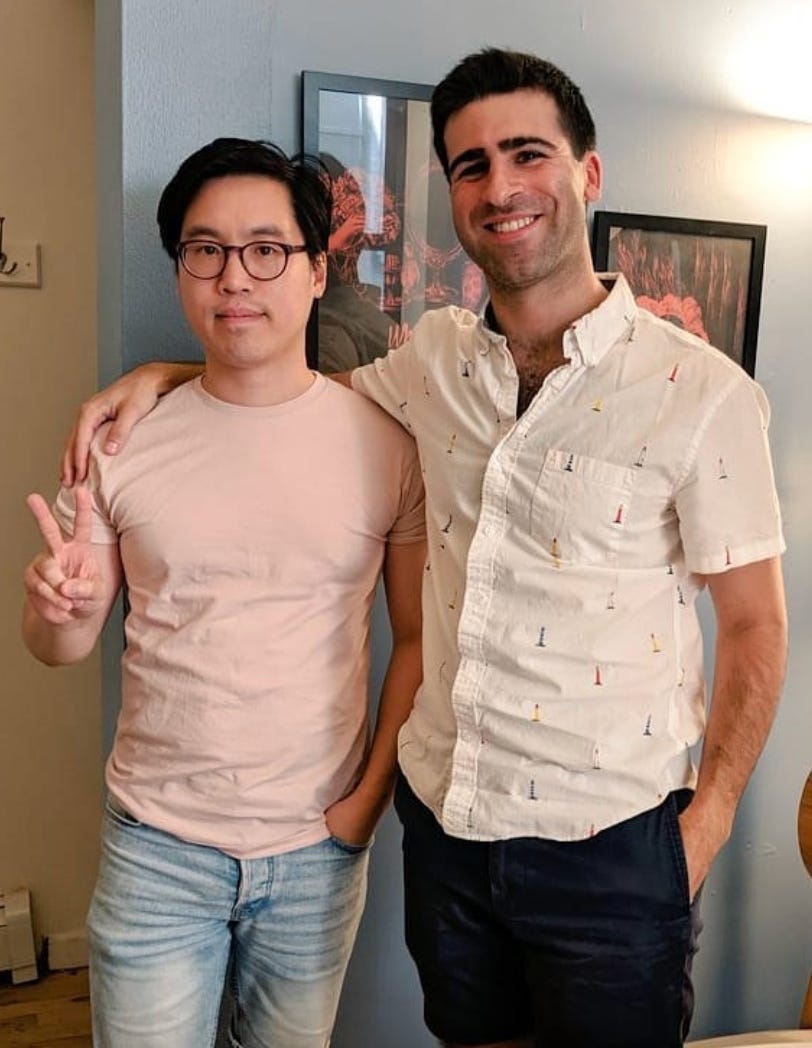
There are pros and cons to this model, where teachers are concerned. As Tony notes, “you can hand-pick your students, set your own hours and rates, design your class from soup to nuts, and you can’t be fired for supporting Palestine.” On the other hand: no health insurance, and certainly no gym.
Inspired by Tony, and staring down my own bleak employment prospects—despite two published novels, an MFA from Iowa, and essays in venues with “New York” in their name, I was struggling to land even an adjunct gig—I decided to start my own class.
I plastered these fliers all over Brooklyn…
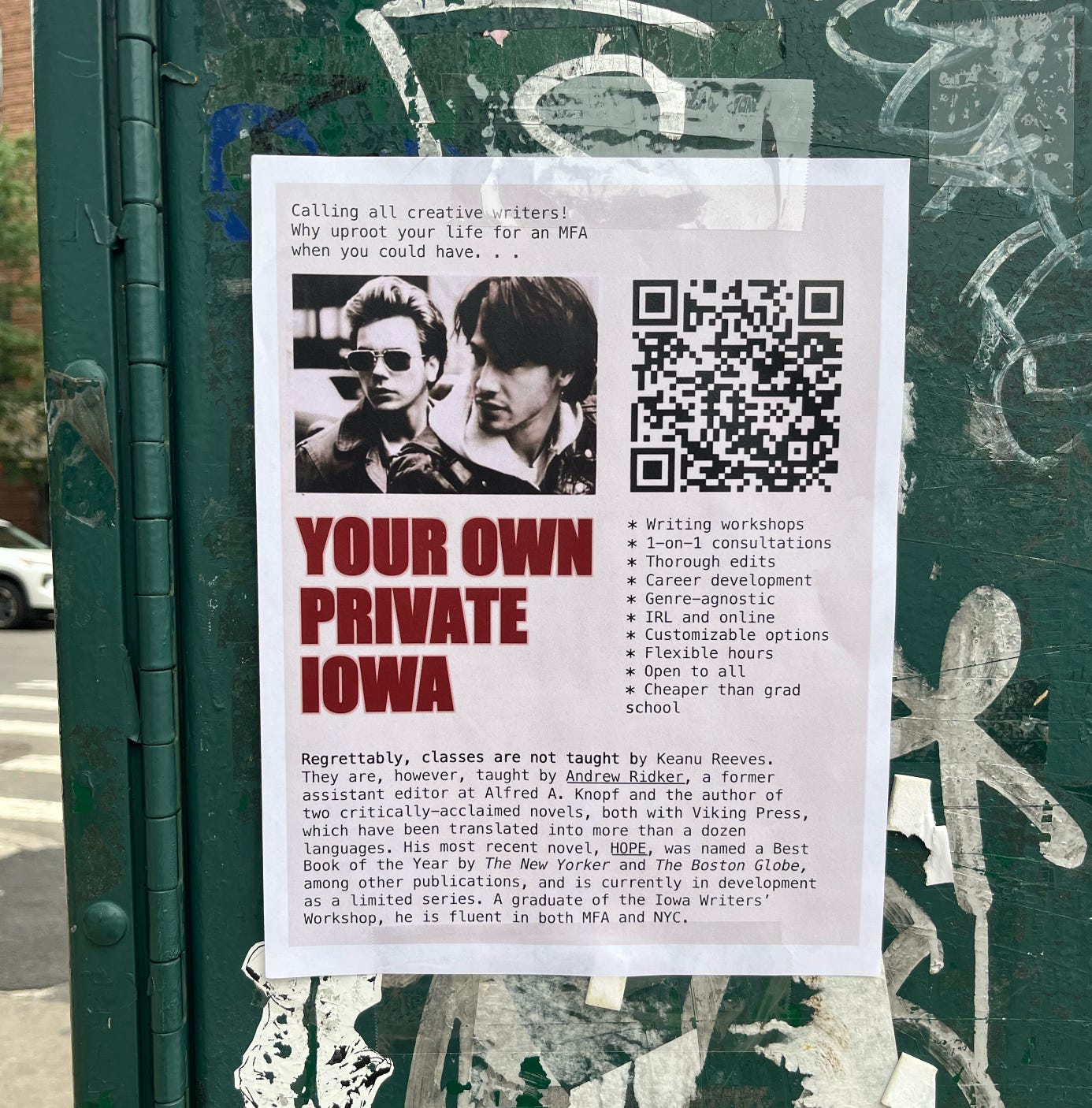
…which, incredibly, did not result in hundreds of applications in my inbox. But Tony referred some of his applicants to me, and soon I had enough students to fill two workshops.
The setup was simple: eight students, nine weeks, everyone workshopping twice. Class would run for two hours, from 7:00 to 9:00 pm, in my living room. (The small class size would foster a feeling of community; also, I only owned nine chairs.) We’d talk plot, point of view, and character development. At the end of the semester we would have "career day,” a session devoted to professional development: how to query agents, how to pitch magazines, and so on. In other words, an MFA in miniature.
I wasn’t sure what to expect. I was inviting sixteen total strangers into my home, where they would share the fruits of their imaginations with people they had only just met. I worried they would talk too much, or too little; that they would be timid and too deferential, or else cruel.
They were none of these things. They were, simply put, some of the brightest, most enthusiastic young people I have ever worked with.2
Their fiction was polished and submitted on time. Their feedback letters to each other were thoughtful, generous, and sharp. They paid close attention to each other’s stories — and attention, wrote Simone Weil, is the rarest and purest form of generosity. By those lights they were exceedingly generous. The seriousness with which they read each other’s work gave them license to take their own writing seriously.
Six months in, the class — now called the Prospect Writers’ Workshop — has started to become a genuine community. Students hang out socially and attend each other’s readings. They come to PWW reunion parties to schmooze with editors, agents, and each other. They recommend the workshop to their friends and colleagues.
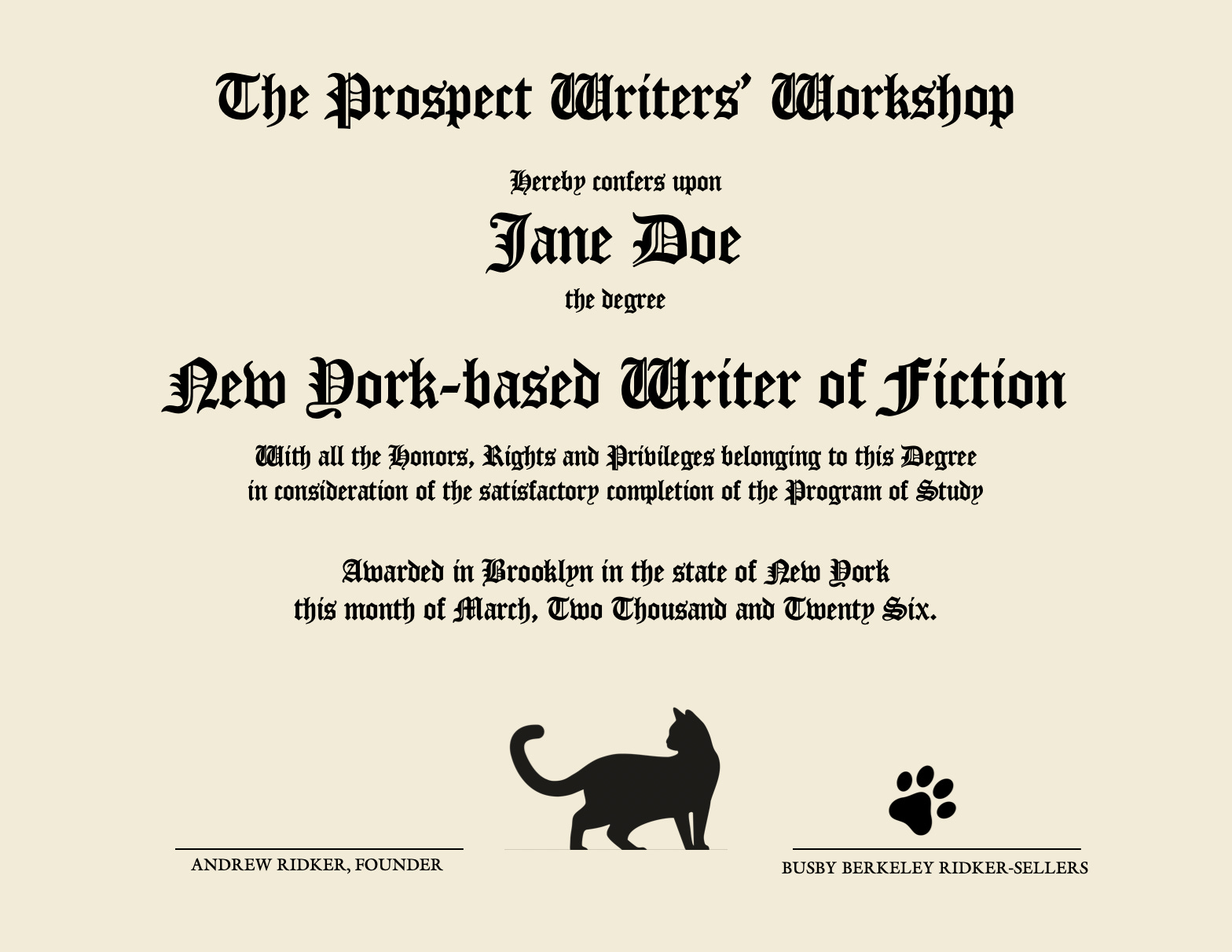
I can’t speak for them, but this budding community has been profoundly important to me. I spent the last four years in semi-solitude, writing and researching my third novel, Power & Light.3 I worked from home, or the New York Society Library, seeing friends and family but stopping short of actively participating in the city’s literary ecosystem. Inviting young writers into my home has, paradoxically, helped get me out of the apartment, to readings and book launches — and out of my own head. I’m excited to bring the workshop to Boston, where I will be moving this summer, though it breaks my heart to walk away from the community I’ve only just started to build.4
Fortunately, there are other writers taking up the mantle. In the last week alone I’ve met with two fellow novelists to talk about the classes they plan to start. And Tony still runs CRIT, which is as popular as ever. I don’t know why every writer who likes to teach isn’t doing this. I hope more will.
I haven’t given up on academia. Neither has my grandma, who calls me every week to ask if I’m attending the MLA convention. But for now, at least, I take pride in having made a DIY MFA, a micro-university — albeit one without a gym.
Her love life inspired the following lines from my second novel, Hope, in which a middle-aged man reflects on his mother’s exes: “They were engineers and economists, historians and experts on foreign policy. If she were to be believed, and this was no small if, his mother had slept with half the Brookings Institution.”
Most students in the first cohort were in their mid-to-late twenties, which remains the most common age group among applicants, but there were also students in their thirties, forties, and fifties.
Out next year from Viking / Penguin!
Nah, you're leaving as soon as I find out about this?
"Fortunately, there are other writers taking up the mantle. In the last week alone I’ve met with two fellow novelists to talk about the classes they plan to start"
Could you link to these? CRIT is actually on hiatus for 2026 (devastating).