
Is Publishing a Meritocracy?
What this post presupposes is...maybe it isn't?

A few weeks ago, a friend sent me a post about the state of publishing. Like many posts on literary Substack that go viral, or at least fungal, this one is a critique of the industry. I’m sympathetic to many its arguments. Thanks to any number of factors — corporate consolidation, declining attention spans and literacy rates — it’s only getting harder to get published, much less read and reviewed. If you don’t believe me, check out literally any other article on Substack. Posting Ls has become a genre unto itself, especially among the fellas.
But I bristled at the central thesis of the post, which is that the entire system is broken, as evidenced by the fact that Robert Olen Butler, who won the Pulitzer in 1993, was turned down for meetings by 36 agents through AWP’s “Agent to Writer” program.
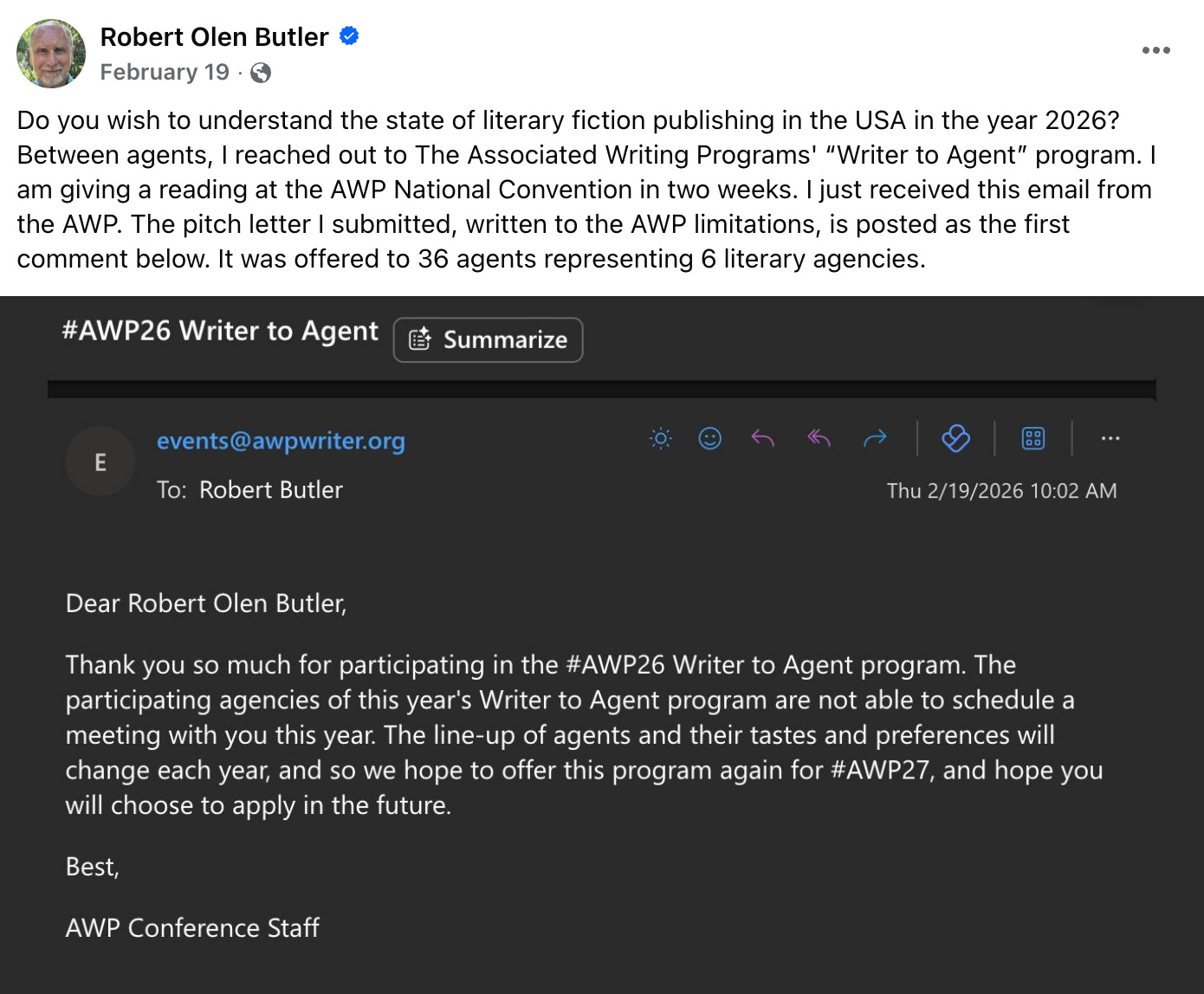
I understand why it might seem shocking to learn that a Pulitzer winner with a short story prize named after him couldn’t even get a sit-down with one of those agents. Strangely, however, the author of the post, Renee Nicholson, attributes Butler’s rejection to his query letter, which he shared on Facebook:
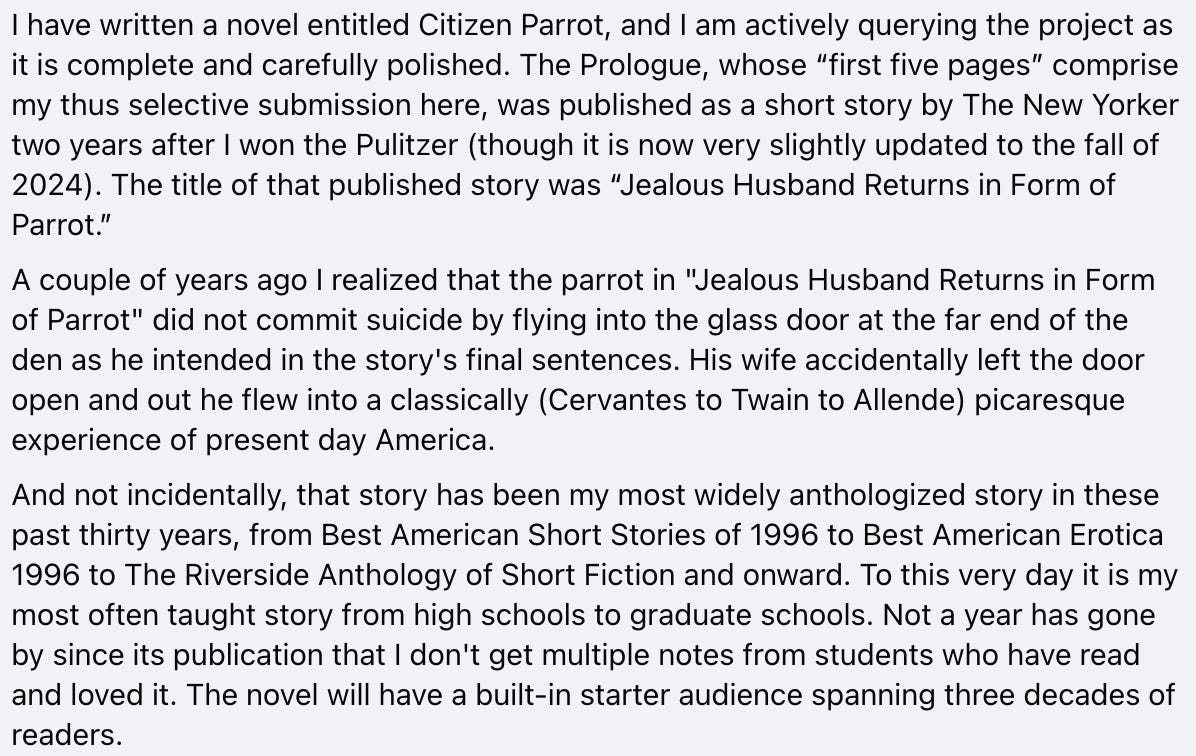
“The query-as-filter,” Nicholson writers, “was designed to find marketable packages. Butler’s New Yorker publication and Pulitzer Prize didn’t register in this case because the query he posted on Facebook didn’t meet the standards of the form. . . . Robert Olen Butler didn’t fail to write work of merit. He failed the marketing document test.”
Now, I hate query letters as much as the next guy. I don’t think it’s reasonable to expect authors — most of whom are introverted if not mentally ill, though rarely with the mental illness they think they have — to take the novels they have toiled over for years and process them into a snappy, marketable, algorithm-friendly pitch. If novelists could write ad copy, they would. There’s more money in it. And while Butler’s query is a little unconventional, I don’t think that’s why the agents turned him down.
Allow me to offer a few other explanations, in order of ascending relevance:
The Writer to Agent program is not for Robert Olen Butler.
Why an octogenarian with more than twenty published works of fiction, who no doubt knows countless agents, applied to a program that is all but explicitly intended to support what we in the biz call “emerging writers” is beyond me. If anything, it’s a red flag.
Robert Olen Butler is crazy.
As Emily Gould reported in Gawker almost twenty years (!) ago, Butler sent his colleagues and students a deranged email on the occasion of his fourth wife, Elizabeth Dewberry, leaving him for a certain (now recently-deceased) media mogul:
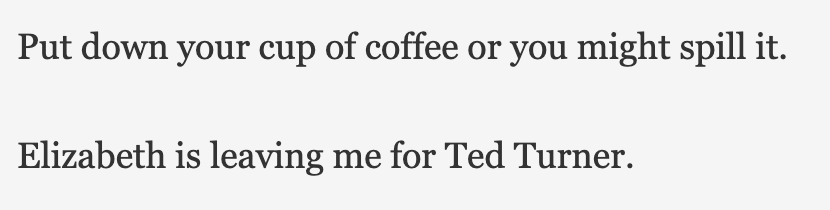
The email is unbelievably lurid, and deserving of its own Pulitzer in the category of Self-Abasement. If you don’t believe me, here are some choice excerpts:
It is very common for a woman to be drawn to men who remind them of their childhood abusers. Ted is such a man, though fortunately, he is far from being abusive.
Elizabeth has never been able to step out of the shadow of the Pulitzer.
In March, she nearly died from an intestinal blockage in Argentina while on a trip with Ted. The trauma of that led her further to profoundly question her own identity.
She will not be Ted's only girlfriend. Ted is permanently and avowedly non-monogamous. But though he has several girlfriends, it is a very small number, and he does not take them up lightly and he gives them his absolute support when he does.
Again, writers have every right to be crazy. They usually are. But if I deploy my own Writerly Empathy and imagine what an agent would think when reading an email like this, I might pass on a meeting, too.
But this is all a prelude — The Prologue, if you will — to what I suspect is the real reason Butler didn’t book a meeting.
3. Publishing is not a meritocracy.
This sounds obvious enough, but it is something every writer, editor, and agent must discover for herself. When I got my first job in publishing, working as an editorial assistant at Alfred A. Knopf, I was genuinely shocked to learn that I was working for a business and not some vaguely charitable enterprise that awarded money to authors on the merits of their prose. I wrote about this in my second novel, Hope, in which one of the characters takes a job in publishing.
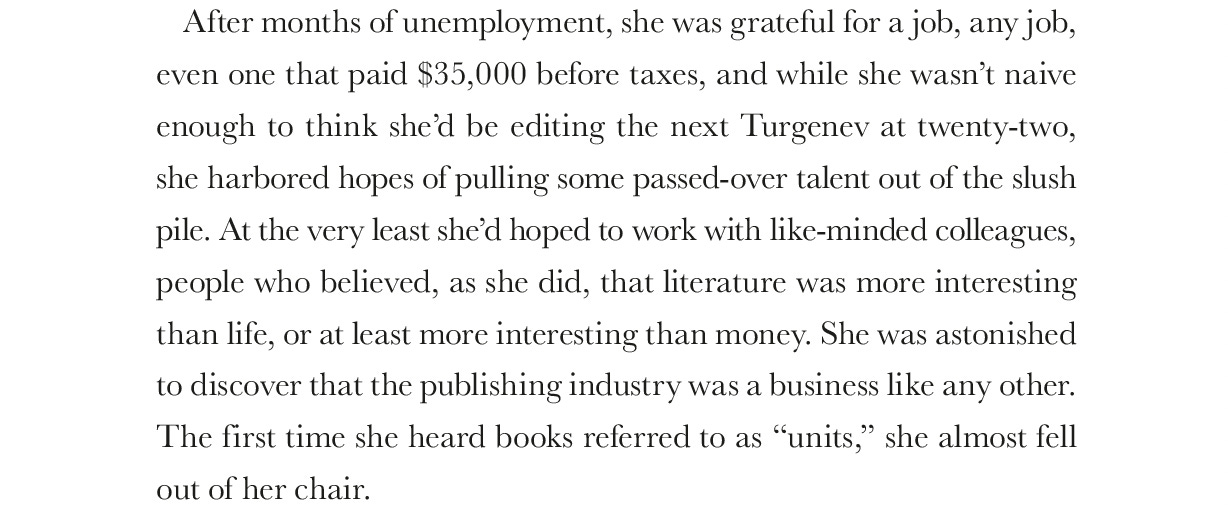
This, basically, is how I felt. Once, we bought an ostensibly literary but poorly-written novel on the merits of its high-concept premise, with the editor remarking, “we can fix the language later.” Another time, we bought a turgid and decidedly unfrightening horror novel of the strength of the author’s previous book sales; part of my job entailed “finding places to put scary stuff in.” And this was Knopf! There were Nobel Prizes mounted on the walls!
One of the reasons I left publishing was that my tender heart couldn’t bear this kind of talk. In order to write, you have to believe in the power of literature, which is different — and often diametrically opposed — to the power of the marketplace. (The best editors and agents I know are the ones who are able, like gay Catholics or liberal Zionists, to hold two contradictory belief systems in their minds at once, and to endure the psychic agony that it entails.)
This is all to say that if agents didn’t want to meet with Robert Olen Butler, it was probably because they didn’t think they could make money off his books. Simple as that. A Pulitzer is no guarantee of future sales, especially when more than thirty years and almost twenty books have passed since the prize was awarded. Even more so when those books is Intercourse, a short story collection about the mid-coital musings of Adam and Eve, Pocahontas and John Smith, the Nixons, the Clintons, and — holy shit, is he for real? — “Santa Claus & Ingebirgitta (elf).”
The best editors and agents I know are the ones who are able, like gay Catholics or liberal Zionists, to hold two contradictory belief systems in their minds at once, and to endure the psychic agony that it entails.
Writing a book can be a lot of things: an act of faith, a form of self-expression, a testimony. Publishing a book is a business proposition. Lincoln Michel has written elegantly about the intersection of art and commerce. I remain fascinated, and at times appalled, by the way the business works. But it is a business.
And a brutal one, at that. In the comments section of one of Michel’s posts, Kristen McLean, an industry analyst for BookScan, shared the following numbers for a data set of roughly 45,000 books published over the course of one year:
0.4% or 163 books sold 100,000 copies or more
0.7% or 320 books sold between 50,000-99,999 copies
2.2% or 1,015 books sold between 20,000-49,999 copies
3.4% or 1,572 books sold between 10,000-19,999 copies
5.5% or 2,518 books sold between 5,000-9,999 copies
21.6% or 9,863 books sold between 1,000-4,999 copies
51.4% or 23,419 sold between 12-999 copies
14.7% or 6,701 books sold under 12 copies
No one in their right mind thinks that the .4% of books selling more than 100,000 copies are, by virtue of their popularity, the “best” books published in a given year.1 So why do we persist in thinking of publishing as a meritocracy?
Well, for one thing, publishing is a lot closer to a meritocracy than many other industries. Yes, it’s true that editors will sometimes publish their friends, but this happens much less often than, say, a Duke grad gets a choice position at his dad’s law firm. There aren’t a lot of ways to cut corners as a writer. To publish a book, you have to first write a book, and a decent (or at least readable) one at that. No one’s going to do it for you.
And then there’s the Darwinian sense we have that the best books, the ones that survive, must be the fittest, when in fact it takes a great deal of effort to place a book in the canon, and keep it there. That’s not to dismiss the books themselves — they do have to survive on their merits in order to speak to future generations — but they also depend on infrastructure and enthusiasm. It’s a communal effort.
In conclusion, publishing is a land of contrasts! Really, though, what I love about books is that they don’t bend to Darwinism, capitalism, or really any other ism I can think of. They’re not microwaves or vacuum cleaners. They have a special, incalculable value. That’s why we have public libraries, where you can access virtually any book for free, a proposition that would cripple almost any other industry.
Most novelists are introverted if not mentally ill, though rarely with the mental illness they think they have.
To be sure, a lot needs to change in our literary culture. We need safeguards in place to protect authors and publishers, the way France has l'exception culturelle for cinema. We need more state-supported funding for the arts. And we need more readers, especially younger ones.
Will measures like these make publishing more robust, or even just? I don’t know. But I do know a lot of agents and editors, the “gatekeepers” that many people on this app seem to think are out to get them, personally. They are not out to get you. They are out to make a living. But believe me when I tell you that they are hoping — desperately hoping! — to fall in love with the next manuscript that comes across their desk.